
PE Christmas Trees vs PVC Christmas Trees

Oct
PE and PVC are materials used for artificial Christmas tree foliage. PE tips are moulded to create three-dimensional needles; traditional PVC needles are cut from thin sheets. A tree can use both materials, so a description such as “realistic” does not by itself mean the foliage is 100% PE.
This guide explains how to read those material descriptions and what to check before choosing. If your main question is which look suits your decorating style, start with our hyper-realistic vs traditional Christmas tree comparison.
What are PVC Christmas tree needles?
PVC stands for polyvinyl chloride. For traditional artificial-tree foliage, thin sheets are cut into narrow strips and attached around a branch. From close up, the individual strips have a flatter profile than moulded needles.
That describes the foliage construction, not the complete tree. A PVC tree can still have a full silhouette, a slim shape or a lighting option. Look at the actual product photographs and specifications rather than treating “PVC” as a summary of everything you will receive.

What are PE Christmas tree needles?
PE stands for polyethylene. It can be moulded into tips with a three-dimensional needle shape, allowing manufacturers to reproduce details associated with natural evergreen branches. The result depends on the mould, colour and finished branch arrangement.
Mason’s FirTECT page describes the use of moulded PE for realistic foliage. For an individual tree, read its own material description as well. A photograph of one branch does not establish the composition of every branch on the model.

PE, PVC and mixed-material trees
Some artificial trees combine moulded PE tips with PVC foliage further inside. This can pair detailed outer branches with a fuller interior. Finding PVC inside a tree described as realistic is therefore not, by itself, a mismatch.
| Description | What it tells you | What to check |
|---|---|---|
| PVC foliage | Traditional cut-strip needles. | Close-up texture, branch coverage and the finished outline. |
| PE tips | Moulded needle detail is part of the design. | Whether other foliage materials are also used. |
| PE/PVC blend | Both materials are used in the foliage. | Their stated placement and any declared proportions. |
| Realistic or hyper-realistic | A description of the intended appearance. | The product’s material specification; do not infer a PE percentage from the name. |
If a percentage is provided, ask what it measures: the number of tips, the foliage material or another basis. If no percentage is published, do not estimate one from a photograph. Compare the outer and inner branches, then decide whether the finished tree has the appearance you want.
What should you check before buying?
1. Confirm the material description of the exact model
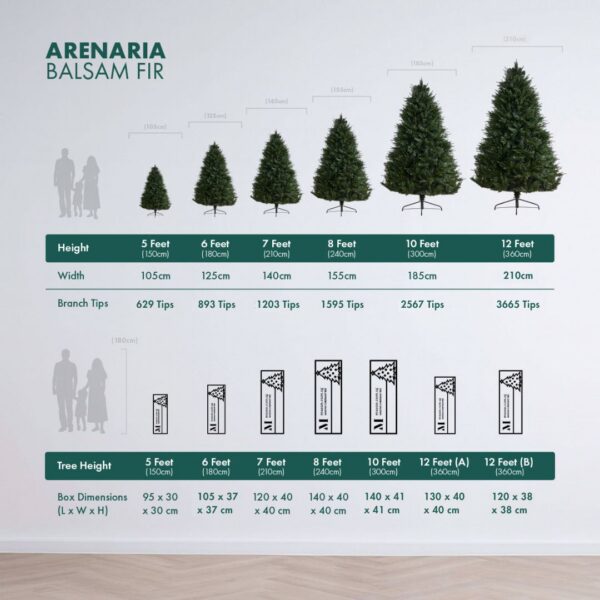
Save the model name, selected height and setup type on your shortlist. Read its description and inspect the branch close-ups. For example, Mason’s product pages for Astoria Douglas Fir Slim, Aramanta Noble Fir and Arenaria Balsam Fir let you inspect different foliage styles. These names are model references, not a declaration that every one has the same material mix.
2. Separate material from weight and storage
If you need to carry the tree upstairs or lift it onto a storage shelf, request the assembled weight, heaviest section and packed dimensions for your selected size. A generic weight quoted for a “6 ft PE tree” cannot establish the weight of another 6 ft model. Include the stand and any attached lights when checking what you will need to handle.
3. Read care and warranty information separately
Do not interpret PE or PVC as a promise of a particular lifespan. Check how the selected tree should be shaped, packed and stored, and which parts its warranty covers. Likewise, a description of soft foliage does not establish that the complete product is suitable for unsupervised use by children. Follow the product’s intended use and care instructions.
4. Check the room fit and lighting independently
Neither material tells you the tree’s width or whether lights are included. Use the height and width guide for room measurements, then the Pre-Lit vs Standard guide for the lighting decision. This keeps three separate questions clear: what the foliage is made from, whether the tree fits and how you will light it.
Questions worth asking about an unclear listing
- Which materials are used in the outer tips and inner foliage?
- Does any stated percentage apply to this exact model and height?
- Can I see an undecorated tree and a clear branch close-up?
- What are the weight, packed dimensions and care instructions for my selected version?
Once those details are clear, compare the complete price of the configurations you actually want. Choose the finish that suits you, with the right dimensions and setup, rather than deciding from the material abbreviation alone.
For the wider purchase decision, see our Christmas tree buying guide.
Traditional Christmas Trees


Christmas Trees
You save
845+ bought in the past week

Christmas Trees
You save
997+ bought in the past week
Hyper Realistic Christmas Trees


Christmas Trees
You save
1217+ bought in the past week


Christmas Trees
You save
849+ bought in the past week


Christmas Trees
You save
43+ bought in the past week

Christmas Trees
You save
458+ bought in the past week

Christmas Trees
You save
1350+ bought in the past week
Browse the full Christmas tree collection or find more practical advice on our Christmas blog.